Product Guides
GHG Protocol — Scope 3 Category 3: fuel- and energy-related activities
What Category 3 covers, its four sub-activities (upstream fuels, upstream energy, T&D losses, sold energy), and why renewable electricity still generates Category 3 emissions.
The GHG Protocol Scope 3 Standard defines Category 3 as:
Emissions related to fuel- and energy-related activities not included in Scope 1 or Scope 2.
It captures the upstream and network-level greenhouse gases that sit around your energy use but don’t show up in Scope 1 (which tracks combustion you control) or Scope 2 (which tracks the generation of the electricity and heat you buy). In Dcycle, Category 3 is calculated automatically once your Scope 1 and Scope 2 data is in — there’s no separate upload step, but understanding what it contains helps you interpret your dashboard and answer stakeholder questions.
| Your Scope 1/2 activity | → | Category 3 upstream impact |
|---|---|---|
| Scope 1: Stationary combustion (boilers, heaters) | → | Activity A — upstream extraction & refining of that fuel (WTT) |
| Scope 1: Mobile combustion (fleet vehicles) | → | Activity A — upstream production & transport of that fuel (WTT) |
| Scope 2: Electricity purchased | → | Activity B — upstream generation of the power consumed |
| Scope 2: Electricity purchased | → | Activity C — T&D losses in the grid to deliver that power |
The four sub-activities
The GHG Protocol splits Category 3 into four activities, labelled A through D.
Activity A — Upstream emissions from purchased fuels
Extracting, processing and transporting natural gas, diesel, petrol, or any other fuel to your facility generates emissions before the fuel even arrives. Activity A captures those upstream impacts.
What drives it: every unit of fuel you burn in Scope 1 also triggers a proportional upstream chain.
Data source in Dcycle: derived automatically from your Scope 1 combustion records (stationary combustion, mobile combustion, fugitive emissions). No extra entry needed.
Activity B — Upstream emissions from purchased energy
Similar to Activity A, but for the electricity, steam, heat and cooling you buy (your Scope 2 consumption). Generating that energy requires fuel — typically gas or coal — and that fuel had its own upstream chain before it reached the power plant.
What drives it: your Scope 2 electricity and heat consumption.
Data source in Dcycle: derived from your electricity and gas invoices recorded as Scope 2.
Activity C — Transmission and distribution (T&D) losses
When electricity travels from a power plant through the grid to your meter, some of it is lost as heat in cables and transformers. To deliver you 100 kWh, the grid had to generate roughly 106–110 kWh (depending on the country). The extra generation needed to cover those losses has emissions, and those emissions belong to you — proportional to how much electricity you consumed.
Formula:
Emissions = Electricity consumed (kWh) × Upstream emission factor (kg CO₂e / kWh) × T&D loss rate (%)
Data source in Dcycle: derived from your electricity invoices. Dcycle applies a country-level T&D loss rate and an upstream emission factor automatically.
Activity D — Generation of electricity, steam, heat or cooling that is purchased and resold
This activity applies only to energy utilities or companies that buy energy in bulk and resell it to third parties. If you purchase electricity from a supplier and then charge it through to a tenant, for example, those downstream sales generate emissions attributed here.
Most organisations do not report Activity D — it is only relevant if your business model includes energy resale.
How Category 3 appears in Dcycle
Dcycle calculates Category 3 automatically from your existing Scope 1 and Scope 2 data. The table below shows exactly what each upload triggers:
| What you upload | Dcycle calculates automatically |
|---|---|
| Fuel invoice (stationary combustion) | Scope 1 combustion + Category 3 Activity A (WTT upstream) |
| Vehicle fuel consumption | Scope 1 mobile combustion + Category 3 Activity A (WTT upstream) |
| Electricity invoice | Scope 2 electricity + Category 3 Activity B (upstream generation) + Category 3 Activity C (T&D losses) |
You’ll see Category 3 broken out in the Scope 3 → Category 3 row of your emissions dashboard, with Activities A, B, and C shown separately where the data is available.
No upload required
Category 3 is the one Scope 3 category that requires no additional data entry. Focus on getting your Scope 1 and Scope 2 data complete and accurate — Category 3 follows automatically.
Checking which emission factor databases Dcycle uses
For Category 3, Dcycle uses country-level upstream and T&D emission factors sourced from the International Energy Agency (IEA). You can verify this directly in the app:
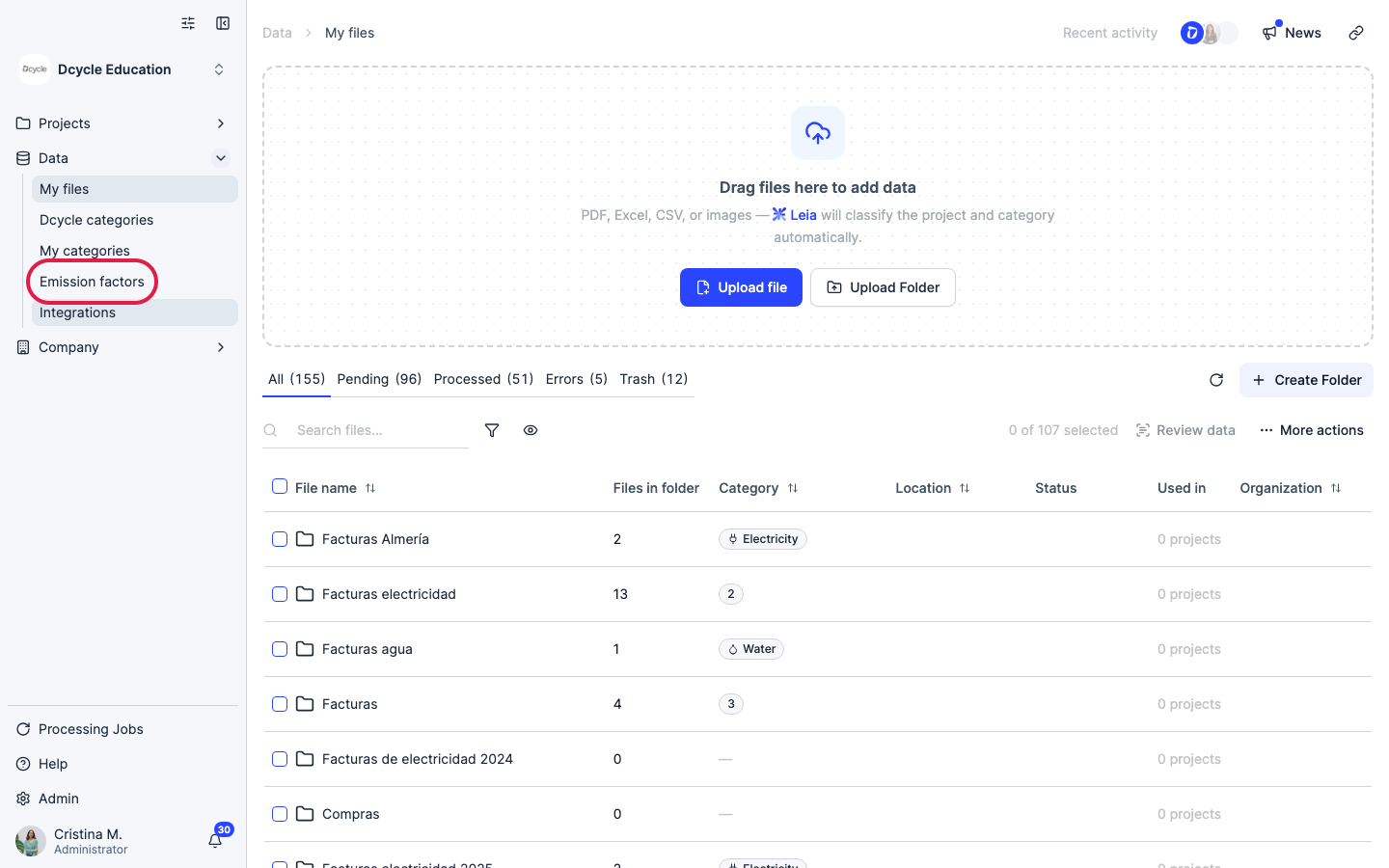
Step 1. Click Data in the left navigation, then click Emission factors.
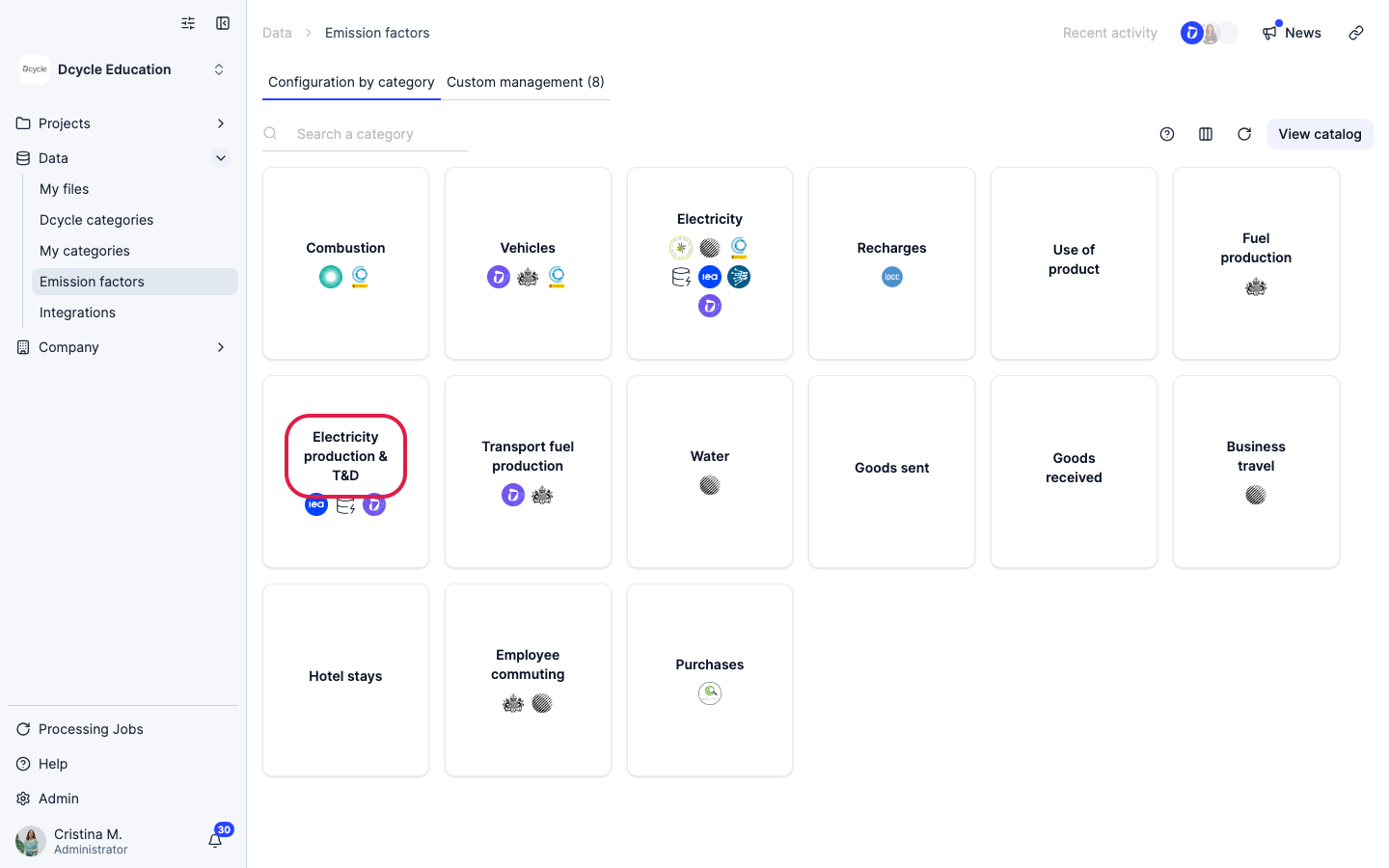
Step 2. Click Electricity production & T&D.
Step 3. The table shows every record with its Type (Production or T&D), the Database used (IEA), and the EF Version. The Default databases panel on the right lists the source databases by country for both sub-activities.
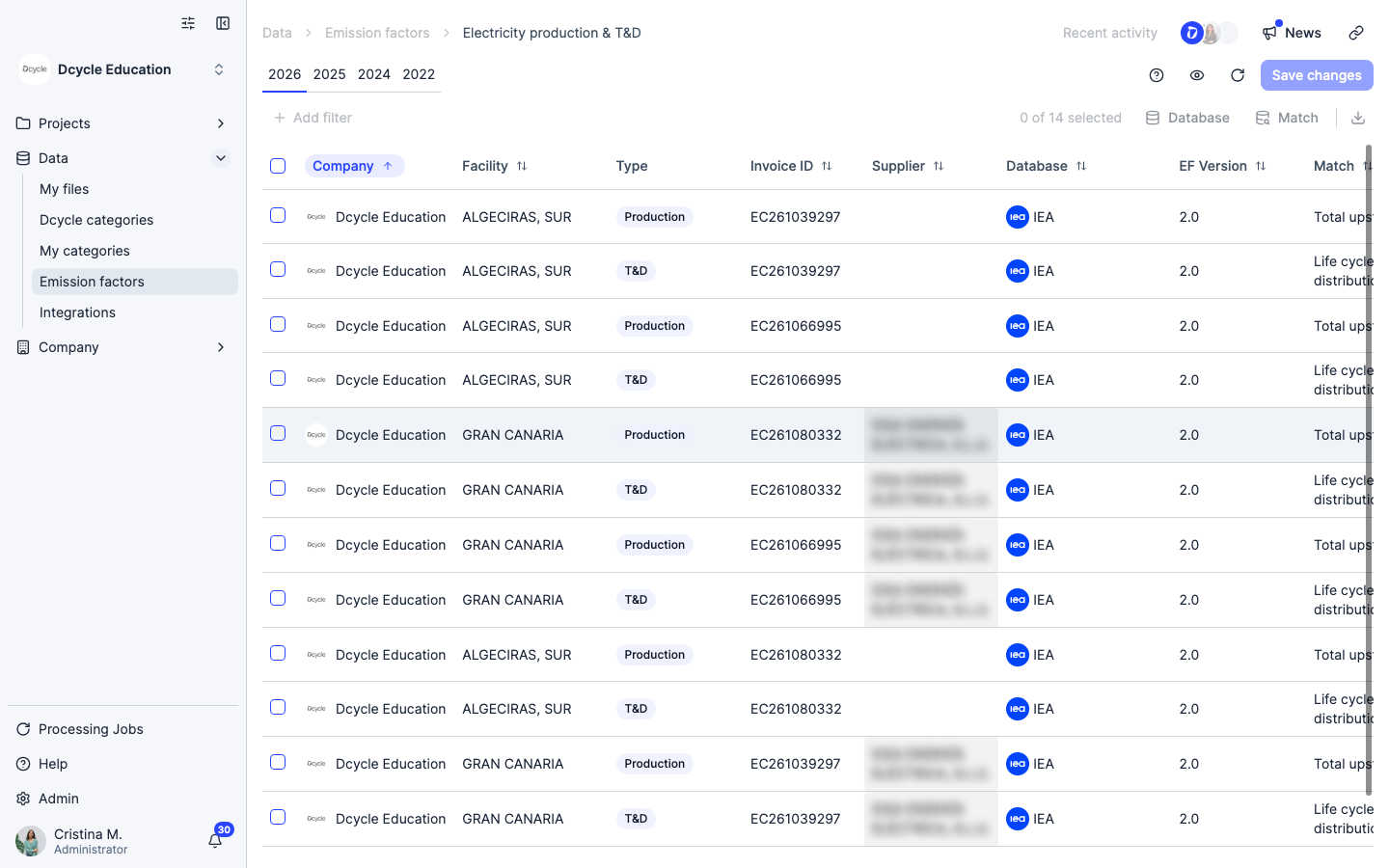
You’ll see two row types — Production (Activity B, upstream generation) and T&D (Activity C, transmission and distribution losses). For most countries the source is IEA; where a more specific national database is available, Dcycle uses it and lists it as an alternative.
This view is read-only — it is informational only, so you can share the source with auditors or stakeholders.
Reference: GHG Protocol sources
Category 3 is defined in detail in:
- GHG Protocol Corporate Value Chain (Scope 3) Standard, Chapter 5, pp. 33–46
- Technical Guidance for Calculating Scope 3 Emissions, Category 3, pp. 37–48
Frequently asked questions
Why does Category 3 show emissions if my energy is renewable?
This is one of the most common surprises in a GHG inventory. Here’s the short answer: the Scope 2 market-based method (which can give you zero) and the Category 3 T&D loss calculation use different emission factors.
When you hold a Guarantee of Origin (GoO) or renewable energy certificate for 100% of your electricity:
- Scope 2 (market-based): the emission factor for your electricity is zero, because your certificate matches you to a renewable generator. Dcycle reflects this as 0 kg CO₂e for Activity A2.
- Category 3, Activity C (T&D losses): the emission factor used here is the grid average upstream factor, not your supplier’s factor. This represents the mix of fuels that had to be extracted and burned somewhere in the system to keep the grid running and cover transmission losses — including losses on lines that carried your electricity to you. Even if your electrons came from a wind farm, the distribution network is shared and some of its losses were covered by fossil generation.
In other words: your GoO cancels the emissions from generating the electricity you consumed. It does not cancel the emissions embedded in the losses that occurred while the electricity was being transported to you.
Practical implication: a company with 100% renewable electricity will still see a small but non-zero figure in Category 3, Activity C. This is correct and expected under the GHG Protocol. It is not a data error.
Is Category 3 mandatory to report?
Under the GHG Protocol Scope 3 Standard, companies must evaluate the relevance of all 15 Scope 3 categories and include those that are significant. Category 3 is typically considered relevant for any organisation with material Scope 1 or Scope 2 emissions, so in practice most reporters include it. CSRD (ESRS E1) also expects disclosure of Scope 3 where material.
Can I reduce my Category 3 emissions?
Indirectly, yes — reducing Scope 1 and Scope 2 consumption automatically reduces the upstream and T&D activity in Category 3. Beyond that, choosing suppliers with lower upstream emission factors (for fuel or electricity) also reduces Activities A and B. The T&D loss component (Activity C) is largely outside your direct control; it depends on grid infrastructure.
Why is the upstream emission factor different from the Scope 2 location-based factor?
The Scope 2 location-based factor covers combustion emissions at the power plant only. The upstream factor for Category 3 adds the extraction, processing, and transport of the fuel used at the power plant — the full lifecycle up to the point of combustion. This is why the Activity B and C factors are always slightly higher than the Scope 2 location-based factors you might be used to seeing.
Was this helpful?
What was missing or unclear? (optional)
Sent. Thank you for helping us improve.
Up next
GHG Protocol tutorial: measure your full carbon footprint in DcycleA guided, top-to-bottom walkthrough of a GHG Protocol inventory in Dcycle — Scope 1, Scope 2 and Scope 3, with a screenshot guide for every category Dcycle supports.
Read more → Upload an electricity invoiceElectricity is Scope 2 — energy you buy and consume on-site. Each consumption record is linked to a facility, so make sure the facility exists first (see "Setting up your facilities in Dcycle").
Read more → Set electricity emissions to zero with a Guarantee of OriginIf you buy electricity backed by a Guarantee of Origin (GdO), its market-based Scope 2 emissions are zero. This guide shows how to switch the market-based factor on your electricity records to the renewable (GdO) option in Dcycle, so those invoices stop counting CO2 — without re-uploading or deleting any data.
Read more →