Learning Hub
MITECO reduction plan: how to get the Reduzco badge
How to design a five-year emission reduction plan, register it with MITECO, and earn the Reduzco badge — required before you can offset.
 Dcycle Team 6 min
Once your footprint is registered (Calculo badge), the next step is to commit to a reduction plan. The plan is submitted alongside your first footprint and is required for registration. Over time, if you demonstrate that your organisation is effectively reducing, you earn the Reduzco badge.
MITECO treats offsetting as a complement to reduction, never a substitute. Without the Reduzco badge, you cannot apply for the Compenso badge.
What the plan must include
There is no rigid template, but the plan needs at least:
| Element | What it means |
|---|---|
| Base year | The reference year you measure progress against |
| Reduction target | A quantifiable goal (e.g. −25 % in Scope 1 + 2 over five years) |
| Time horizon | Minimum five years, aligned with the Paris Agreement |
| Reduction measures | Concrete actions with KPIs, owners, and a timeline |
| Intensity metric | Emissions per unit of activity (e.g. tCO2e per million euros of revenue) |
The plan must be realistic, measurable, and show a genuine intention to reduce.
Step by step
1. Define your base year and target
Choose a representative year as your reference. A 20–30 % reduction over five years in Scope 1 + 2 is a common range, but the right target depends on your sector and starting point.
If your organisation had a previous plan that has expired, the base year for the new plan must be the last year of the old plan. For example, if the plan covered 2022–2025, the new plan starts in 2025 and must cover at least five years (2025–2030 minimum).
2. Identify reduction measures
Review your main emission sources and assign concrete actions. Common examples:
- Energy: purchase electricity with Guarantees of Origin (GoOs), install rooftop solar, improve energy efficiency.
- Fleet: electrify vehicles, optimise routes, upgrade to Euro 6 standards.
- Facilities: improve insulation, replace boilers, control refrigerant leaks.
- Value chain: select lower-footprint suppliers, optimise logistics.
Each measure should have an associated KPI so you can track progress.
3. Build the plan document
Dcycle helps you generate a decarbonisation plan that includes:
- Executive summary with your base-year footprint and target.
- Detail of each measure with estimated impact in tCO2e.
- Implementation timeline.
- Year-by-year reduction projection.
4. Register the plan with MITECO
From the registry portal, add your reduction plan to your existing footprint registration. Attach the plan document as supporting evidence.
5. Receive the Reduzco badge
Once validated, your badge is updated to include Reduzco. This appears publicly on the MITECO portal.
How Reduzco activation works
Having an active plan is necessary, but for the “Reduzco” portion to activate on your badge, you need to demonstrate a real reduction trend. The criteria are:
- You must have your carbon footprint registered for four consecutive years.
- MITECO calculates the three-year moving average of your emission ratio (footprint divided by your activity index) and compares it to the previous three-year average.
- If the current average is lower than the previous one, the reduction is recognised and Reduzco is activated on your badge.
This means an organisation that has just registered its first footprint will only have the Calculo portion active. Reduzco appears when the downward trend is proven with real data over several years.
Typical timeline
| Phase | Estimated time |
|---|---|
| Define measures and target | 2–4 weeks (with Dcycle support) |
| Build the plan document | 1–2 weeks |
| Submit to MITECO | 30 minutes (online form) |
| MITECO validation | 2–6 weeks |
How Dcycle helps
- Analyses your footprint to spot the sources with the highest reduction potential.
- Generates a decarbonisation plan with projections, measures, and KPIs.
- Simulates reduction scenarios under different combinations of measures.
- Supports annual progress tracking against your target.
Leia: your decarbonisation plan, generated from your data
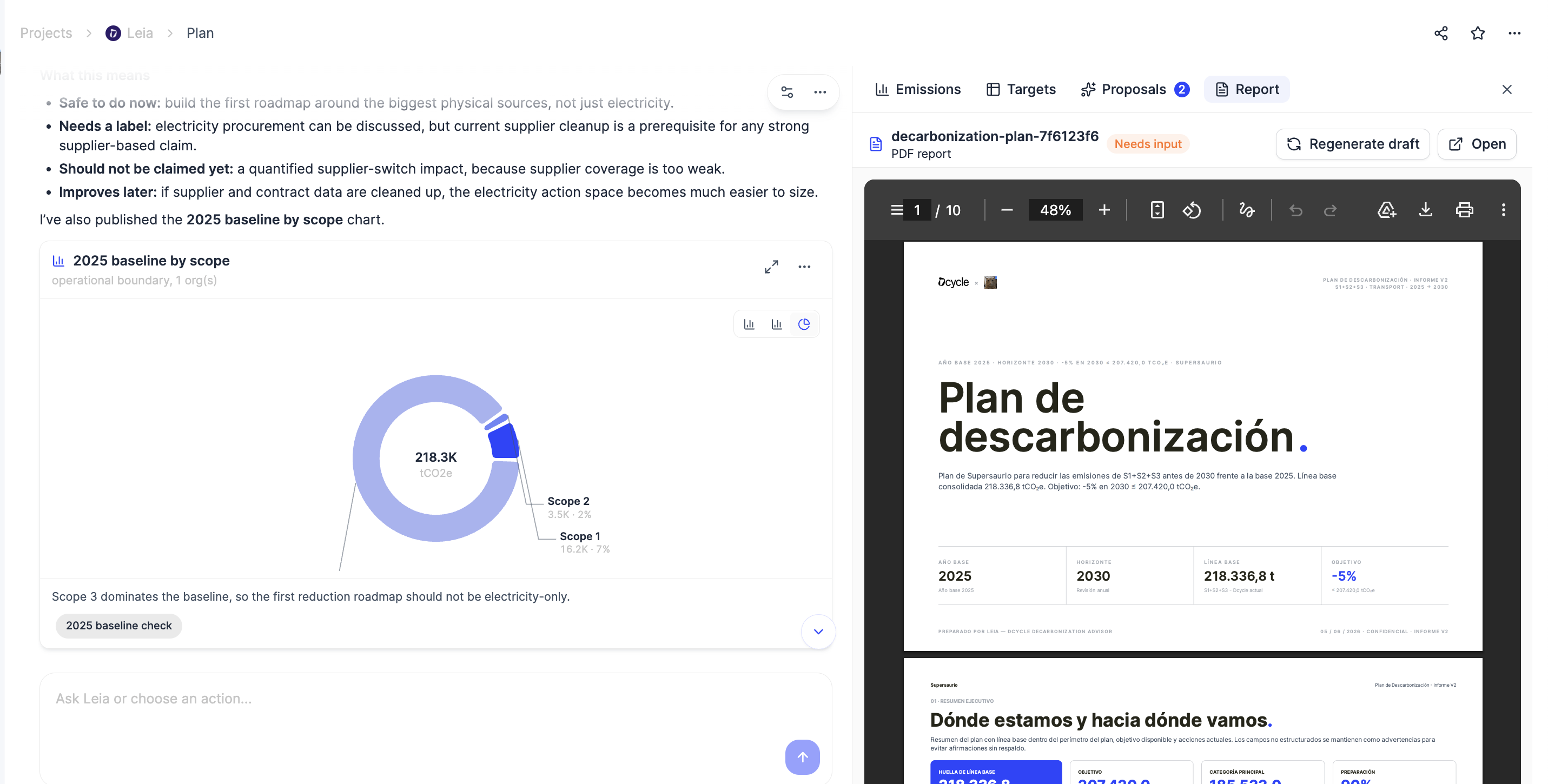
Dcycle's decarbonisation module includes Leia, the operational intelligence layer built into the platform. Leia is not a generic chatbot: it reasons directly over your real emission data to generate your plan.
Leia scans your full footprint, identifies hotspots (the categories driving your emissions), and proposes prioritised reduction actions with estimated effort, return, and impact in tCO2e. You accept, edit, or discard each action.
The result is a decarbonisation plan aligned with MITECO requirements, ready to attach to your registration. Every data point and every proposal is traceable back to its original source.
For more details, see the official MITECO Carbon Footprint Registry page.
Common questions
Do I need to have reduced already to get the badge? To have a plan registered, no. But for Reduzco to activate on your badge, you need four consecutive years of registered footprint and must demonstrate a reduction trend in the intensity ratio (three-year moving average compared to the previous three-year period).
What happens if I don’t meet my plan targets? Meeting the reduction plan targets is not mandatory. Failing to reach your self-imposed targets has no consequences for your registry registration. However, if you want Reduzco to appear on your badge, you do need to demonstrate a real reduction trend.
Do I have to submit follow-up reports? Yes. Annual tracking is mandatory. Every year, when you register your footprint, you must upload a follow-up report to the MITECO registry with the progress and implementation status of your reduction measures. Dcycle helps you generate this tracking automatically from your data.
Does the plan have to cover Scope 3? The Royal Decree does not require it, and most organisations leave Scope 3 out of their first plan. You can add it in future revisions.
How often do I update the plan? The plan covers a minimum of five years (mandatory from 1 January 2026). The time horizon is counted from the footprint’s calculation year. It is good practice to review it annually to adjust measures and update progress data.
What if my previous plan has expired? The base year for the new plan must be the last year of the old plan. For example, if your plan covered 2022–2025, the new plan starts in 2025 and must cover at least five years (through 2030 minimum).
My group has international operations. Do I need a Spain-specific plan? Yes. MITECO only accepts Spanish entities in the registry. If your group operates in multiple countries, you will need two plans:
- One plan for the full group (required by the Royal Decree).
- One Spain-only plan (for MITECO registration).
What if my company grows and absolute emissions increase? That is why the intensity metric matters. MITECO evaluates reduction based on the emission ratio (footprint divided by activity index), not absolute emissions. You can show that your efficiency is improving even if absolute volumes rise due to organic growth.
Was this helpful?
What was missing or unclear? (optional)
Sent. Thank you for helping us improve.
Up next
MITECO carbon footprint registry: how to get the Calculo badgeHow to measure your carbon footprint, register it with Spain's MITECO, and earn the official Calculo badge — the first step toward Reduzco and Compenso.
Read more → MITECO carbon offsetting: how to get the Compenso badgeHow to offset your carbon footprint through verified absorption projects, complete the transfer and registration process with MITECO, and earn the Compenso badge.
Read more →